OpenSSH in Production
Trust, Access, Forwarding, and Failure Analysis.
Early access
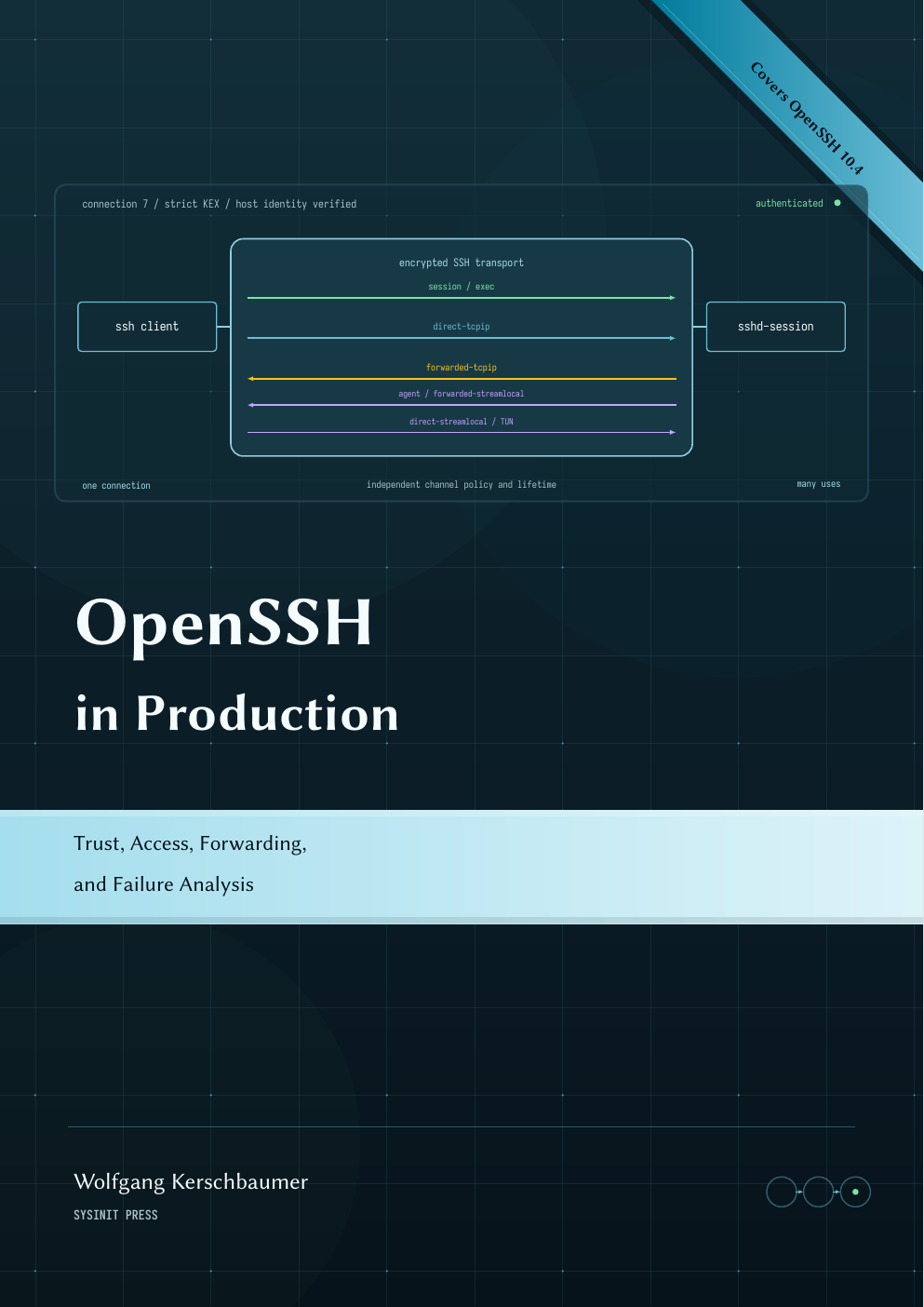
The book treats OpenSSH as four separate layers: configuration, transport, authentication, and channels. It uses a pinned OpenSSH 10.4 source tree to explain what each layer owns and how it fails. The example catalog was run on two lab nodes, with evidence retained for review. The troubleshooting method asks which process made the decision and which observation rules out the next plausible cause.
Status: all 20 chapters and 5 appendices are written and lab-verified; the 345-page build has passed its release gates and the final review is in progress. Early access includes the current build as PDF and EPUB, the examples archive, the audiobook edition, and every build until release.
Polar handles the secure checkout. The finished book ships DRM-free as PDF and EPUB, with free updates.
Reader poll Readers pick which Sysinit Press title we finish next. OpenSSH in Production is on the ballot.
Vote for this bookHow OpenSSH makes and enforces decisions.
The early chapters trace connection setup, host trust, authentication, and sessions. Later parts cover forwarding, multiplexing, automation, audit, and fleet policy. The final chapter turns those mechanics into a troubleshooting method. Open a part to see its chapters.
What this book assumes, and how to read it
Part 1 Foundations 4 chapters
- 1 Architecture and Execution Model
- 2 Lab and Evidence Discipline
- 3 Client and Server Configuration
- 4 Transport and Cryptography
Part 2 Trust and Authentication 4 chapters
- 5 Host Trust, Discovery, and Rotation
- 6 Keys, Certificates, KRLs, and SSHSIG
- 7 Authentication Policy and Multifactor Sequences
- 8 Agents, FIDO Authenticators, and PKCS#11 Providers
Part 3 Sessions and Server Policy 3 chapters
- 9 Sessions, Commands, and Pseudo-Terminals
- 10 Command Containment
- 11 Defending sshd as a Service
Part 4 Routing and Channels 4 chapters
- 12 Proxies, Jump Hosts, and Connection Placement
- 13 Forwarding as Listener, Channel, and Connect
- 14 Unix Sockets, Stdio Channels, and TUN/TAP
- 15 Multiplexing and Connection Lifecycle
Part 5 Operations at Scale 4 chapters
- 16 SFTP and SCP
- 17 Automation
- 18 Observability and Audit
- 19 Fleet Policy
Part 6 Troubleshooting 1 chapter
- 20 Troubleshooting Field Guide
Part 7 Appendices 5 appendices
- A Source and Option Map
- B Algorithm and Version Boundaries
- C Uncommon Practitioner Cookbook
- D Sources, Evidence, and Reproducibility
- E Glossary and Subject Index
For people who already use SSH every day.
This book is for senior Linux administrators, SREs, platform engineers, incident responders, and security engineers. It assumes that you can create keys, read a manual page, and operate a service. It is an advanced book.
- Administrators and SREs who debug SSH failures under time pressure and want discriminating observations instead of blanket workarounds.
- Security engineers running certificates, KRLs, multifactor policy, and host trust rotation at fleet scale.
- Engineers who use forwarding, jump hosts, and multiplexing daily and want to know which endpoint opens which socket.
Get early access.
Early access is the complete, lab-verified book at a reduced price while the final review runs. You get the current build as DRM-free PDF and EPUB right after checkout, the examples archive, the audiobook edition as MP3 and chaptered M4B (about 9 hours; the narration is AI-generated), every new build until release, and the finished book at release, with free updates afterwards.
Hear when a new build lands.
The build list announces new early access builds of Sysinit Press titles, each with a short summary of what changed. It carries nothing else.
The signup uses double opt-in. Every message includes an unsubscribe link.
Or wait for the release.
The shared Sysinit Press book list carries release news, sample chapters, and updates to published editions.
The signup uses double opt-in. Every message includes an unsubscribe link.